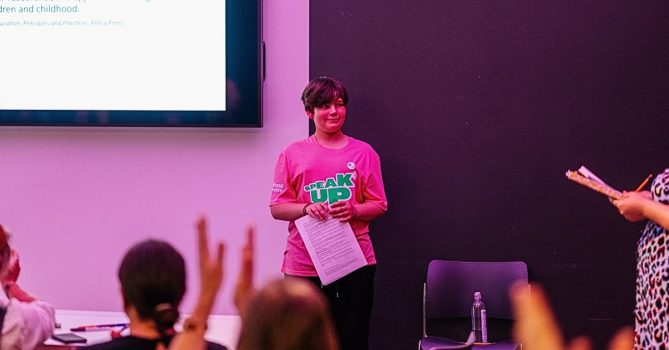
Creative methods, cultural vitality and relational consultation practice
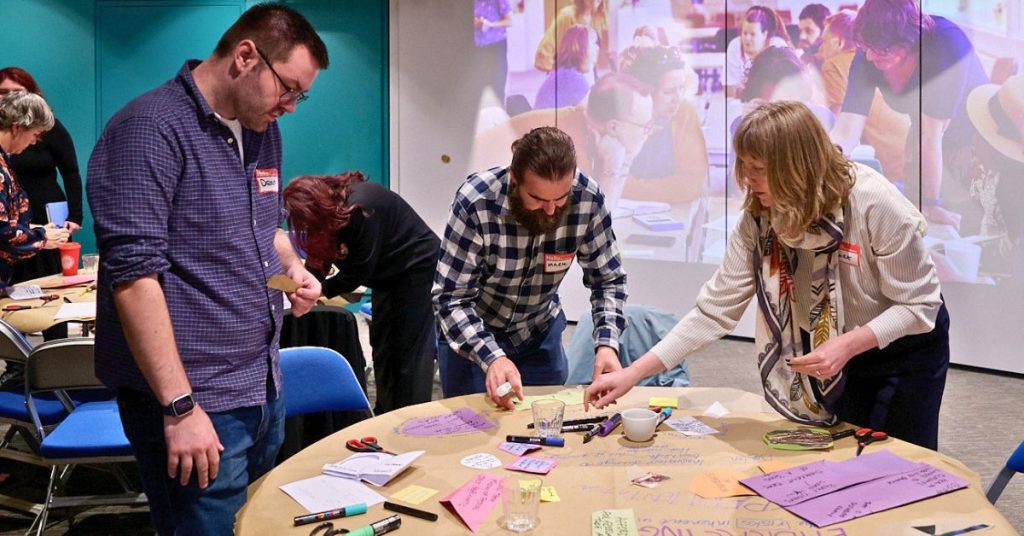
Holly Sandiford is a facilitator, evaluator and socially engaged artist. Working with Norwich Creative City Compact, she has been facilitating a series of three Cultural Vitality Labs as part of the Centre’s work, putting cultural vitality theory into practice. Holly shares her reflections on this work and how creative methods played a key role in spotlighting and connecting the many voices of the Norwich cultural sector.
It is difficult to convey in words and explore something as messy and interconnected as cultural vitality. In my role as a community researcher, I have been using creative methods to collectively explore cultural vitality in Norwich in a more visual, embodied and sensory way. I view myself as a co-researcher, working alongside Norwich’s cultural community, which includes freelancers, grassroots collectives and larger organisations. An important aspect of this work has been the idea of cultural ecology, and I have been bringing this to life through collaborative mapping, collective making and creative methods that make space for quieter voices while helping people see themselves as part of a wider, interconnected ecology.
Across the three Labs, we explored what supports cultural vitality, the barriers, what is missing, and how people across the city might work together. Through the final Lab, we have also developed a shared Theory of Change, enabling us to consider how we can collectively contribute towards a healthier cultural ecology for Norwich.
Consultation fatigue, extractive practice and reciprocity
Research processes can often feel extractive. We are constantly being asked for our feedback, ideas and lived experience, often without knowing what happens with this information. This can be especially challenging when you consider people’s backgrounds, lived experience, ethnicity and the physical and emotional resources they have available at any given time.
How can we make research more enjoyable, reciprocal and relational? For me, that means creating processes where people gain something in return for taking part. This might mean sharing creative facilitation or research methods they can use in their own work, creating opportunities to develop relationships and new ways of thinking, or simply offering a genuinely reflective and enjoyable experience.
If the overall research question is centred on wellbeing, connection or cultural vitality, then the process itself should also contribute to those things. In this case, we were researching cultural vitality, so I designed resources that nourished connectivity and community. Through walking, making, listening, drawing, laughing and reflecting together, the research process itself worked to strengthen the ecology it was exploring.
Creating an atmosphere of trust has also been important. My experience shows me that people contribute more generously and openly when they feel safe, welcome and connected to those around them. Using exercises that connected and grounded people before discussions, including deep listening, drawing and quieter reflective activities, helped people feel more relaxed within the group and able to contribute their ideas and opinions.
Access and creativity
My approach to facilitation is shaped by my background in creative health practice. I have worked with people with lived experience of mental health challenges, living with dementia, and with learning disabilities, as well as young people, refugees and asylum seekers, and many others who may struggle to engage through more traditional discussion-based approaches.
This way of working has shaped how I think about access and design. When you design around different learning styles, communication styles and access needs, everybody benefits. Using movement, materials, sound, visuals and practical making alongside discussion often creates much richer responses than relying purely on verbal discussion.
Across the Labs, we used methods including walking, mapping, collage, tracing paper layering, sound recording, drawing, photography, meditation and large collaborative making processes. These creative methods spark different parts of the brain and can move people beyond rehearsed or fixed responses.
While some people may find conceptual frameworks and language immediately easy to grasp, others may need to physically work through ideas in order to understand and connect with them. This is particularly important when working in the cultural sector, where there are often high levels of neurodivergence and many people who lean towards thinking visually, creatively or spatially.
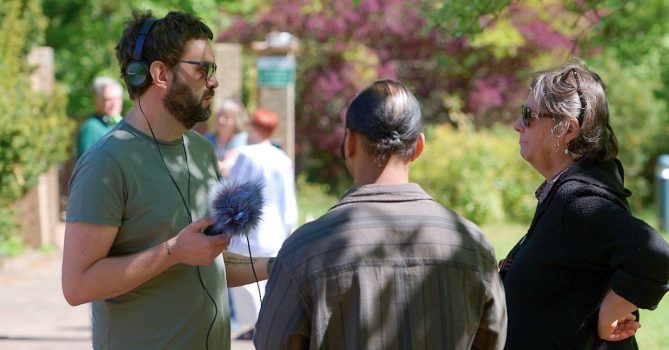
Walking felt particularly important within this work. When people move together through a place, listen deeply and notice things collectively, conversations often become less rehearsed and more thoughtful. Ideas emerge gradually through observation, conversation and experience. I often find that some of the richest reflections happen side by side while walking rather than sitting around a table.
Making cultural ecology visible
One of the strongest parts of the process for me was the large-scale mapping and layering work that happened across the three Labs.
Using collage, tracing paper, drawing, writing and collaborative making allowed people to physically work through abstract ideas of cultural vitality and cultural ecology. These are complicated frameworks and ideas. I’m a visual thinker myself, so part of my process became finding ways to physically and visually work through those ideas to deepen my own understanding.
What emerged was much broader than organisational mapping. People were layering conversations around care, access, exhaustion, local knowledge, informal support, visibility, barriers, friendship, belonging, funding pressures, physical spaces, memory, participation and the emotional realities of working within the cultural sector in Norwich.
We added a layer of tracing paper over the first collaged and drawn map to add perspectives, tensions and connections without erasing what was already there. Different experiences could sit alongside each other. Contradictions could remain visible. People could respond across layers rather than feeling pressure to simplify everything into a single agreed version.
As the maps became denser, people started noticing links, gaps and patterns that may not have emerged through discussion alone.
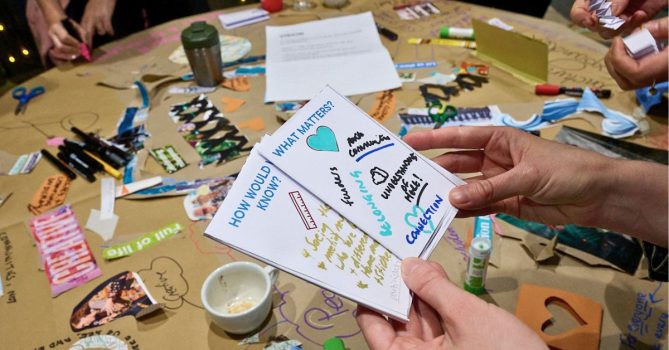
The final Lab built on this by developing a shared Theory of Change. Participants reused maps, quotes, reflections, photographs and notes from across all three Labs to build a shared understanding of what supports cultural vitality in Norwich and what needs protecting, strengthening or changing.
I found this process particularly interesting because it highlighted both the possibilities and challenges of this kind of work. Cultural vitality and cultural ecology are complex ideas, and what seemed to make the biggest difference was people physically working through them together. Cutting things up, moving them around, debating them and building something collectively helped to make the framework less abstract.
The process also reinforced the importance of continuity. The earlier Labs had gradually built a shared language and understanding through walking, making, discussion and reflection. For people who joined the process later, it was naturally harder to connect with some of the ideas. That reminded me that collective understanding takes time and that learning often happens through participation rather than simply receiving information.
Different ways of contributing
As a freelancer and someone who has worked across many different roles in the sector, from leading organisations and managing staff to working as an artist, facilitator and evaluator, I have an awareness of the different pressures we carry. People are exhausted and stretched, and for structural reasons, some will also find it much harder or more draining to participate fully in these spaces.
I was aware of the need not to centre dominant voices. In a room where you have larger organisations alongside freelancers, artists and grassroots groups, some people will naturally feel more confident speaking than others. We worked in pairs and small groups, with individual reflection, as well as whole-group discussion and making activities, creating multiple opportunities for people to contribute. Sometimes the quieter contributions were the most insightful.
Creating the conditions for contribution felt just as important as the methods themselves. Creative warm-ups, listening exercises, walking, drawing and making are not simply activities to fill time. They help people arrive, settle, connect with one another and feel more confident sharing their thoughts. In my experience, the quality of discussion is often shaped before it even begins.
This project has also reminded me that creative facilitation is a continuous process of learning. I am constantly adapting methods from different parts of my practice and trying them in new contexts. Some approaches worked exactly as I hoped, while others revealed unexpected challenges. If we want to find new ways of understanding complex systems and cultural ecologies, we need to leave some space for experimentation, curiosity and learning.
For me, part of the work is also about care, appreciation and atmosphere, recognising the value of people’s time and energy, and creating a process that feels regenerative rather than draining. If people came away feeling heard, creative, connected to others, and having had a genuinely good experience, then that constitutes a successful day.
Continuing to reflect
I’m still reflecting on this way of working and thinking about how it can be further developed. I am interested in how creative methods can help people collectively explore difficult or abstract ideas in ways that feel more human, relational and embodied. How can we hold complexity without flattening it? How can we make relationships visible? And how can the research itself actively contribute to the ecology it is exploring rather than simply extracting information?
Most of all, I’m curious to learn more about how people feel within these processes. Do they feel listened to, able to contribute, connected to each other, and part of a collective experience?
Perhaps my biggest reflection from the Labs is that cultural vitality cannot be fully understood from the outside. It needs to be experienced, explored and built collectively. The methods themselves become part of the ecology they are trying to understand. In that sense, the research is not only gathering information about cultural vitality, but it is also contributing to it.
Holly Sandiford is an artist, creative evaluator and freelance arts facilitator based in Norfolk, with over 25 years’ experience working across arts, creative health, mental health, community and heritage settings. She is currently an Associate Research Fellow at Norwich University of the Arts, an artist with Kettle’s Yard co-creating work with young people and has been working as a researcher with the Centre for Cultural Value. Across her practice, Holly brings together artistic research, facilitation and evaluation as connected ways of working. She is interested in how listening, making, movement and shared reflection can open up different forms of knowledge, particularly in work with communities, lived experience and place.
Connect with Holly on LinkedIn | Connect with Holly on Instagram
Discover more about the Centre for Cultural Value’s cultural vitality research
Coming soon … a new resource sharing more about using creative methods in your evaluation. Join our email list for future updates about Centre resources.
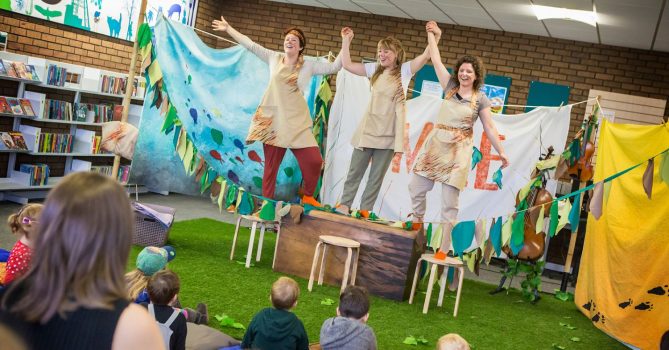
Top Image: Participants taking part in a Cultural Vitality Lab with Norwich Creative City Compact. Photo by Andi Sapey.
Related news
Beyond the bailout: What Italian opera houses reveal about cultural policy
Start from place, not planning. Grounding policy in cultural vitality.
New report: Transforming the Cultural and Heritage Sector’s Data Infrastructure
Cultural Vitality Labs: Placing participatory research and co-production at the heart of cultural evidence
Building the next chapter