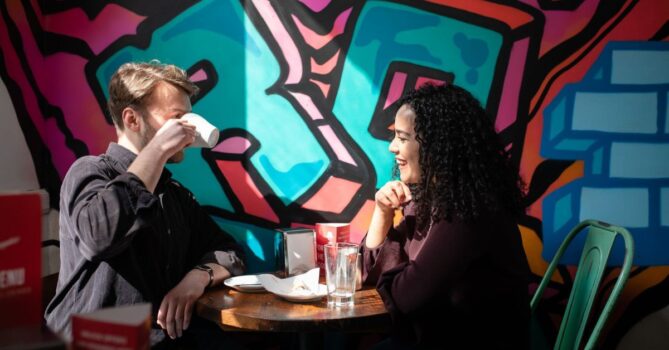
Stepping out of the role – arts approaches in healthcare training

In this joint blog, lecturers Simon Burrow and Dr Helen Pusey reflect on our latest research digest. They look at what evidence is needed to support the integration of cultural approaches in the training and development of medical students.
We are senior lecturers on undergraduate and postgraduate programmes in health and social care (including nursing) at the University of Manchester. It is so encouraging to see the latest research digest from the Centre for Cultural Value, which focuses on the training and development of healthcare students.
One of our main areas of interest is in improving understanding of the lived experiences of people with dementia, and applying this to re-thinking care and support. Clearly, enabling students to meet and discuss experiences directly with people with dementia is a key way of achieving this. However, arts-based approaches offer another, often very powerful, means of stimulating thought and reflection, and in doing so challenging those perspectives we can sometimes take for granted. We particularly value the unique opportunity these approaches offer to address and develop the key attributes of empathy and emotional intelligence in our students.
We have seen first-hand the direct impact of a range of cultural programmes in Manchester, including improvised theatre for post-graduate dementia care students; film-clubs for social work students and guided viewing of art at the Whitworth Art Gallery for healthcare students and qualified staff. What is interesting about these approaches is how they appear to enable students to ‘step out’ of their roles, tasks and expectations of learning and to think and reflect creatively. In these activities, students have the time, space and opportunity to think about the people they work with on a day-to-day basis with a different perspective.
It is particularly helpful that the digest points to emerging evidence that cultural programmes do indeed enable students to gain a greater understanding of patient experience. However, it is of course disappointing to learn that in the most part participation by students is voluntary – thus probably not reaching the very students who might benefit the most.
One of our great challenges as lecturers and course leaders is to win arguments to embed cultural learning in an already crowded curriculum. Evidence that goes beyond the anecdotal can only help with this. Furthermore, tapping into the increasing emphasis on the importance of inter-professional learning may provide a fruitful avenue to further champion this approach.
Ultimately, we would like to see education and training (pre-and post-qualification) for all health and social care staff that embraces the expertise of our colleagues in the cultural sector. What we have found from our collaboration is that we learn from each other. As academics in health and social care we risk becoming complacent in the curriculums we offer. Collaborating with actors, artists and curators brings fresh perspective.
It is important to point out at this time – where the cultural, creative and heritage sectors have been hit so hard by the Covid-19 pandemic – that none of this work can take place without effective and continued financial support for arts and cultural organisations, large and small, and the individuals (employed and independent) who work in this sector. Having personally worked with actors, artists and exhibition curators we have frequently find ourselves as inspired and affected as our students through these collaborations.
We wholeheartedly endorse the recommendation in the digest to extend the evidence base to show how embedding cultural programmes in training and development can make a tangible difference to practice and patient care.
Simon Burrow and Dr Helen Pusey are senior lecturers at the School of Health Sciences at the University of Manchester.
Read and download the Research digest: Training and development of healthcare students.
Image: Healthcare students, University of Leeds
Related news
Cultural Vitality Labs: Placing participatory research and co-production at the heart of cultural evidence
Building the next chapter
Empowering Youth Researchers: how handing over the research reins reveals fresh perspectives and deeper insights
Rethinking Audience Spectrum through a cultural vitality lens
Junction Arts: Fifty years of creative placemaking