Beyond the bailout: What Italian opera houses reveal about cultural policy
When it comes to Italian opera, how can a cultural artform so deeply embedded in national identity require such regular rescue? What might the experience of Italian opera houses tell us about the wider relationship between cultural policy, investment and cultural vitality? Alice Borchi (University of Leeds) and independent scholar Carlo Alberto Petruzzi share more about the impact of short-term political decisions on this vital cultural asset.
Few cultural forms are more closely associated with a nation than opera is with Italy. The works of Puccini, Verdi and Rossini are still among the most performed globally, yet despite opera’s status as one of the country’s most celebrated cultural exports, many Italian opera houses continue to face financial instability, political intervention and uncertain futures.
Around the world, opera companies are grappling with rising costs, changing audience patterns and increasing pressure to demonstrate public value. Opera is expensive, requiring substantial investment in artists, technical expertise and cultural infrastructure. Around the world, opera companies rely on a mix of income – direct or indirect public subsidies, corporate sponsorship, and private patrons – and are unlikely to be sustainable without some form of government support. In the United States, New York City Opera declared bankruptcy in 2013 (and was later revived in 2016), and Miami Lyric Opera followed in 2024; that same year Portland Opera began selling its venue to cover debts (Bash, 2024). Even New York’s Metropolitan Opera – arguably the world’s most well-funded company – is reportedly considering selling artworks to address financial pressures (Lebrecht, 2026). In the United Kingdom, Arts Council England’s decision to withdraw National Portfolio funding from English National Opera prompted a major organisational restructuring and a promised relocation.
The challenges facing Italian opera houses are not unique; however, Italy presents a particularly interesting case because of opera’s unique place within national cultural identity and raises broader questions about how cultural policy shapes the long-term health of cultural institutions and cultural ecosystems.
A cultural symbol and civic pride
Bereson (2003) argues that throughout Italian history, opera houses have been associated with power, prestige and authority, reflecting opera’s status both as a cultural symbol and source of civic pride in the local cultural landscape. This privileged position has also shaped cultural policy. In 1967, the Ministry of Culture recognised opera’s cultural and social value, committing public funding to its preservation and development, eventually granting lyrical-symphonic foundation status to fourteen of the country’s leading opera houses in 1996.
Following new public management trends, like many cultural sectors internationally, opera became subject to reforms designed to encourage an entrepreneurial and business-oriented approach. However, the resulting tension between commercial pressures and cultural missions meant opera houses’ financial independence proved difficult to achieve, and they still significantly relied on public funding.
Despite the introduction of efficiency-oriented policies and the renewed support of public funding, opera houses still face serious issues. The repeated use of public policy and funding interventions in Italy suggests a system focused on organisational rescue rather than cultural ecosystem development.
Thinking beyond individual institutions
A remaining key challenge is collaboration. Even today, opera audiences travelling in Italy may find multiple productions of the same works being staged simultaneously. While this reflects the enduring popularity of the repertoire, it also raises questions about a lack of coordination between institutions, the use of shared resources, creative innovation and collective audience development. For cultural organisations more broadly, it highlights the importance of thinking beyond individual institutions and towards the health of the wider cultural ecosystem.
The close connection between Italian opera and politics may not always be beneficial. Changes in national and local governments can lead to shifts in leadership, priorities and strategic direction, creating instability for opera houses. Political actors often play an outsized role in new appointments and governance of institutions, highlighting the challenge for cultural organisations that need to balance political accountability with cultural autonomy. The case of Carlo Fuortes illustrates this interplay: his movement between leadership roles in Opera di Roma, the Italian national broadcasting company RAI, and the Maggio Musicale Fiorentino, after unsuccessful bids for La Scala and Naples was driven as much by political bargaining and regulatory constraints as by coherent artistic vision.
Questions of place-based development also emerge from the Italian experience. In some cases, administrators have attempted to replicate programming models that succeeded elsewhere, without accounting for local market size, demographics or institutional identity. Florence provides a particularly revealing example: the construction of a new, monumental opera house resulted in the demolition of the historic city-centre opera house, which was replaced by luxury apartments for tourists. While intended as a symbol of cultural investment, the decision raised broader questions about how cities understand value. When cultural infrastructure is lost, what disappears beyond the physical building? Opportunities for participation, collective memory, local identity and civic life may be affected too. Such decisions highlight the importance of thinking about culture not simply through physical assets, but as part of the wider social fabric of a place.
Internal governance challenges have also shaped the sector. The contested appointment of Beatrice Venezi as musical director at La Fenice triggered months of opposition from staff and the wider artistic community before the role was ultimately withdrawn. While the details were specific to one institution, this episode highlights a shared issue: cultural organisations depend not only on funding, but also on trust, transparency and legitimacy. Leadership decisions that are perceived as politically driven or lacking stakeholder support can undermine public confidence and can rapidly become existential risks for the institution.
Breaking the cycle
Such dynamics produce a cycle of reactive governance: short term political solutions, unstable leadership, and fragmented artistic strategy. Breaking the cycle will require insulating appointment processes from partisan pressure, aligning programming with local demand, strengthening internal coordination and prioritising medium term artistic and audience development over immediate headline grabbing initiatives.
The challenges facing Italian opera houses are not simply questions of organisational management. They raise broader questions about how culture is supported, how public investment is directed and what conditions are required for culture to remain meaningful within contemporary life.
A cultural vitality response recognises that effective solutions depend not only on the presence of cultural assets, but on the policy choices and investment decisions that shape their future. Viewed in this light, the question is not whether Italian opera can survive. Rather, it is whether cultural policy can create the conditions for opera to remain a living, evolving and accessible part of cultural life.
That is a question that extends far beyond opera and far beyond Italy.
Alice Borchi is a Lecturer in Creative Industries at the University of Leeds. Her research interests include the study of cultural commons and cultural value, with a particular focus on participatory practices and shared governance in cultural policy and management. A list of her publications can be found here.
Carlo Alberto Petruzzi (PhD, MBA) is an independent scholar and consultant and a former opera industry practitioner. His research spans cultural management and policy, as well as cinema and the performing arts. His most recent publications include Carmelo Bene a Cannes (2025) and Carmelo Bene: una bibliografia (2018). He has translated into Italian works by Guillaume Apollinaire and the Goncourt brothers, and he developed the first series of opera librettos translated into Chinese.
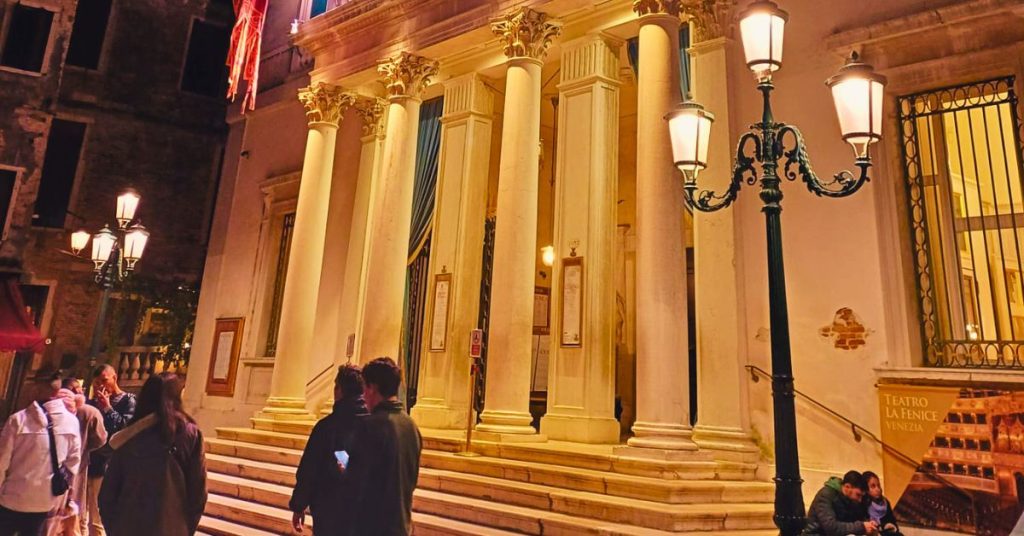
Top image: La Fenice Theatre, Venice. Photo by Alice Borchi.
Related news
Societal Readiness: Could it change how we think about cultural activity?
Creative methods, cultural vitality and relational consultation practice
Start from place, not planning. Grounding policy in cultural vitality.

New report: Transforming the Cultural and Heritage Sector’s Data Infrastructure
Cultural Vitality Labs: Placing participatory research and co-production at the heart of cultural evidence