‘How do we know what audiences get out of it?’ Rethinking evaluation for digital experiences
When cultural organisations experiment with digital and immersive technologies, are we asking the right questions about their value? Following a conference on digital Holocaust remembrance in Budapest, Centre for Cultural Value Research Fellow, Dr Rob Eagle, asks how approaches to evaluation might be more collaborative, creative and continuous.
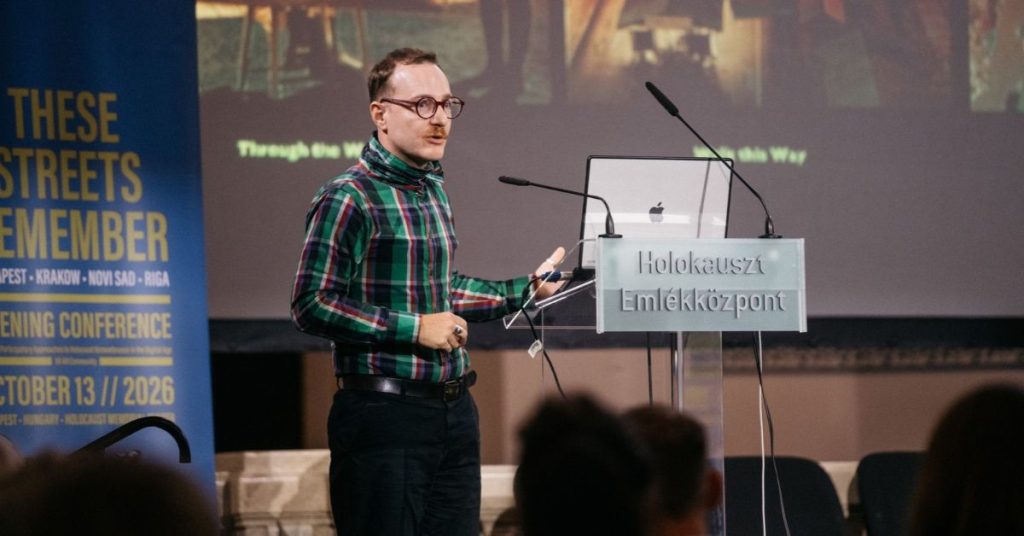
In October, I spoke in Budapest at a symposium on the Ethical and Participatory Approaches to Holocaust Remembrance in the Digital Age, where artists, researchers and heritage professionals explored the ethical questions surrounding digital representations of the Holocaust. My contribution addressed a question that extends beyond Holocaust remembrance: how do we know what audiences get from digital and immersive cultural experiences?
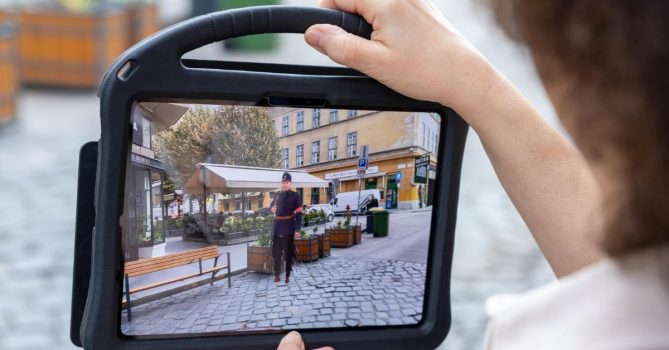
The central project discussed at the conference was If These Streets Could Talk, an immersive history experience by director Barna Szász, co-created with community members, in which the audience walks through a neighbourhood that was part of the Budapest Ghetto from 1944 until its liberation in 1945. Using a mobile device, the audience encounters stories of the Jewish community who lived there through digitally reconstructed historical environments, with characters superimposed onto the contemporary streets around them.
Still in prototype testing with a public release scheduled for 2028, the experience uses augmented reality (AR), which allows digital images, sounds and other content to be experienced in relation to the physical world. Unlike virtual reality, which typically places audiences inside a computer-generated environment, AR brings a layer of digital content onto physical surroundings.
If These Streets Could Talk takes you through streets in Budapest, where you look at the buildings and people around you while encountering stories of events of the Holocaust. The historical narrative becomes layered onto the physical environment, potentially changing how you perceive a place that might otherwise seem ordinary.
But how can we know what audiences take away from such an experience?
In one of the symposium panels, Professor Andy Pearce from UCL’s Centre for Holocaust Education observed that the evaluation of digital experiences often resembles little more than ‘satisfaction surveys’. Audiences are asked immediately whether they enjoyed the experience, found it engaging or learnt something new.
While these questions are useful, they don’t tell us much about an experience’s cultural value. What might we be missing when we rely on these immediate, individual responses to understand something as complex as an encounter with Holocaust history?
Evaluating more than technology
Media scholar Horea Avram (2016) proposes understanding augmented reality as a ‘perceptual phenomenon and not as a technology’. Our experience of AR is a mix of perceiving digital artefacts (audio and 3D scans) and our sensory stimuli and movement through a space – in this case, a street. AR brings a story or game into a three-dimensional space through our bodies and senses. If the story is engaging, what you remember most is the content and the characters, not the technology itself. This is my starting point for evaluating an AR experience.
Evaluating digital and immersive experiences should prompt us to look beyond the effectiveness of the technology or individual users’ satisfaction. We need to understand these experiences as social phenomena, shaped by relationships among artists, audiences, technologies, communities and the places that provide context and history.
In If These Streets Could Talk, the significance of the experience lies partly in the relationship between the historical narrative and the present-day street. An average building or busy shopping area becomes a place through which audiences engage with histories that are otherwise largely invisible.
We could measure how many people participate, whether they complete the experience, how much historical information they retain or how emotionally engaged they feel. These measures might tell us something about its effectiveness, but they do not fully explain how the experience changes someone’s relationship with a place, how its meaning develops through conversations afterwards or whether the audience feels inspired to learn more by visiting a museum or accessing online resources.
For cultural and heritage organisations, this highlights what we choose to value and what we choose to measure.
Beyond the satisfaction survey
Evaluation is frequently designed to demonstrate that a cultural project has achieved its intended outcomes. In digital projects, this can encourage an emphasis on technological performance, usability and immediate audience response. Logistically, short questionnaires are a popular tool – they are relatively inexpensive, straightforward to administer and produce data that can be readily reported to funders. However, they also risk reducing complex experiences to a set of predefined indicators.
This can be problematic when evaluating experiences concerned with difficult histories. An audience member of If These Streets Could Talk might report feeling moved by a story of the Holocaust, but what does that emotional response signify? Does it indicate historical understanding, critical reflection or a deeper awareness of antisemitism? Does the experience generate a discomfort that prompts the audience to reflect on their own responsibilities if they were to witness atrocities? An immediate survey is unlikely to capture the full complexity of these questions.
Evaluation also needs to consider whose perspectives are represented. Cultural organisations and historical institutions have project objectives; artists and storytellers bring their own craft and expectations; and audiences may interpret the resulting work in unexpected ways. These different perspectives are all part of understanding an experience’s cultural value. Evaluating a project should create opportunities to discover what matters to the people involved, rather than assuming the intended outcomes are necessarily the most meaningful.
Collaborative, creative and continuous
In a recent article for Arts Professional, Centre director Stephen Dobson and I proposed three principles for rethinking evaluation with young people: Collaborative, Creative and Continuous. Although developed in the context of youth participation, they offer a useful framework for considering digital and immersive experiences.
Collaborative evaluation begins with the communities and audiences involved. To avoid imposing institutional measures, evaluation should be developed on a community’s own terms, using questions and metrics that make sense to them.
For If These Streets Could Talk, the project’s collaborative approach has involved Holocaust survivors, Jewish communities, local residents, historians and audiences, all defining what meaningful engagement with this history looks like. Their priorities may differ from those of the artists or commissioning organisations, but collaborative evaluation creates space to understand these differences and refine the experience so it is clearer and more effective.
Creative evaluation recognises that conventional questionnaires and interviews cannot always capture the variety of ways people experience art and culture. We experience AR with our bodies, not just our minds. How can our evaluation methods reflect that embodied experience?
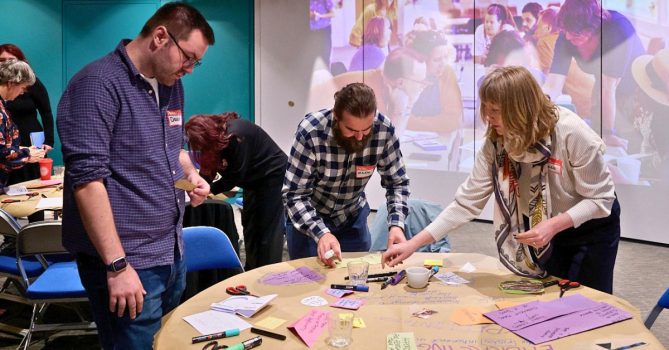
At the Centre, we’ve been using a range of creative methods for evaluation. In this reflective article, Holly Sandiford shares more about how creative methods were built into our recent Cultural Vitality Labs with Norwich Creative City Compact.
Drawing and mapping exercises, audio walks and other embodied techniques help us understand what audiences feel after a cultural experience. These methods can reveal dimensions of participation that may be difficult to express through a rating scale or written response. They can also give audiences greater agency in deciding how they communicate what matters to them, making for a more inclusive evaluation.
Continuous evaluation challenges the assumption that evaluation only occurs immediately after an experience ends. Cultural meaning can develop over time, through conversations, memories and subsequent encounters.
Someone who participates in If These Streets Could Talk might return to the same streets and see the place differently, discuss the experience with others or seek out further historical information. In a 2025 study of the project, 60 people were interviewed before and after trying the prototype. A year later, some participants are reporting that they still remember significant locations from the experience, such as where the ghetto wall had stood. These findings demonstrate the value of following up with audiences over a longer period, alongside embedding evaluation throughout the design process to inform the experience as it evolves.
What do we really want to know?
These three principles are not universal rules. Different digital or immersive experiences require different approaches, and evaluation must remain proportionate to the resources available at that time. Nor should creative and participatory methods entirely replace quantitative research. The challenge is to select methods that meaningfully address the questions being asked.
The Centre’s Evaluation Principles provide a useful foundation for this work, encouraging approaches that are beneficial, robust, people-centred and connected.
For me, the question is ultimately about what cultural and heritage organisations hope to learn from evaluation. Are we primarily interested in demonstrating that a digital experience was successful, or do we want to understand how audiences make meaning through it?
When we evaluate AR as a social phenomenon, we begin to consider the relationships between digital and physical environments and between historical narratives and contemporary communities. These relationships are often challenging to quantify, but they are central to understanding cultural value.
As emerging digital technologies become increasingly present in heritage interpretation and cultural programming, we have an opportunity to rethink how we evaluate them. Beyond asking audiences whether they enjoyed an experience, we might ask how it affected their connection to the people and places around them, and what meanings continue to develop long after the technology is switched off.
This article is based on Rob’s presentation at the Ethical and Participatory Approaches to Holocaust Remembrance in the Digital Age symposium, October 2026.
Further reading and resources
How to … use creative methods in research, consultation and facilitation
How to … conduct a walking interview
How to … co-create an evaluation
Arts Professional: Re-thinking evaluation with young people
The Space: Evaluating digital experiences
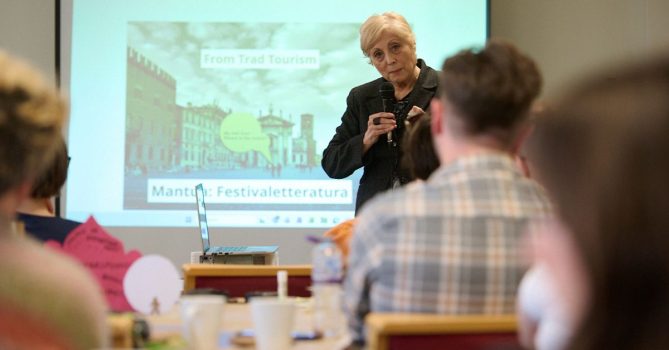
Top image credit: Rob Eagle presenting at Ethical and Participatory Approaches to Holocaust Remembrance in the Digital Age symposium. Photo by David Szarka.
Related news

Societal Readiness: Could it change how we think about cultural activity?
Beyond the bailout: What Italian opera houses reveal about cultural policy
Creative methods, cultural vitality and relational consultation practice
Start from place, not planning. Grounding policy in cultural vitality.

New report: Transforming the Cultural and Heritage Sector’s Data Infrastructure